On this page
- ATSs Were Built to Track Hiring. Hiring Is a Conversation.
- The Trade Hiring Teams Were Forced to Make
- What Is a Conversational ATS?
- From CVs to Evidence
- The Recruiter Should Not Have to Read Every Interview
- What If You Could Talk to Your Hiring Data?
- From Applicant Tracking to Hiring Intelligence
- Where Humans Still Matter
- Who Actually Needs a Conversational ATS?
- We Are Not Trying to Build Another ATS
- Try It on a Real Role
Last year, a founder we know opened a support role in Pune.
By Friday, she had 514 applications.
She read around sixty. She interviewed nine people over the next two weeks. Four of those nine accepted faster offers elsewhere. Eventually, she hired one person she described as “fine.”
Nothing about that story is unusual.
That is the problem.
Her ATS did exactly what it was designed to do. It stored 514 candidate records, moved people through stages, sent automated emails, and kept the hiring pipeline organized.
It tracked everything.
It just did not actually do much of the hiring.
The reading was still manual. The screening was manual. The interviews were manual. The scheduling was manual. The follow-ups were manual.
That gap is why we started building what we now call a conversational ATS.
Not because recruiting needed another dashboard.
Because we started asking a different question:
What if the ATS did some of the conversations instead of simply keeping a record of them?
ATSs Were Built to Track Hiring. Hiring Is a Conversation.
The traditional ATS solved an important problem.
As companies started hiring more people, recruiters needed somewhere to store applications, resumes, interview notes, emails, feedback, and candidate statuses.
That made the ATS the system of record for recruiting.
But being the system of record is not the same as being the system that does the work.
A candidate applies. The ATS stores the application.
A recruiter opens the resume. The ATS records the stage.
A recruiter schedules an interview. The ATS records the interview.
The recruiter conducts the conversation. The ATS stores the notes.
At almost every important step, the human is still doing the actual work.
And that becomes a serious problem when applications arrive by the hundreds or thousands.
The Trade Hiring Teams Were Forced to Make
High-volume hiring traditionally leaves teams with two uncomfortable choices.
Choice one: screen manually.
You get real conversations and human judgment, but the process becomes expensive and slow. A recruiter can only conduct so many first-round calls in a day.
Meanwhile, good candidates are waiting.
And candidates do not wait forever.
Choice two: automate the screening.
This usually means keyword filters, knockout questions, or one-way assessments.
Those tools can process large numbers of applications, but they often reduce a complicated candidate into a collection of keywords and checkboxes.
A strong candidate can be rejected because the right phrase was missing from a resume.
A good communicator can be reduced to a form submission.
A candidate can be asked to record answers into a camera without ever having an actual conversation.
We did not like either trade.
So we built toward a third option.
What Is a Conversational ATS?
A conversational ATS is an applicant tracking system that does more than track candidates.
It can communicate with them, evaluate them, collect evidence, and turn those interactions into structured hiring data.
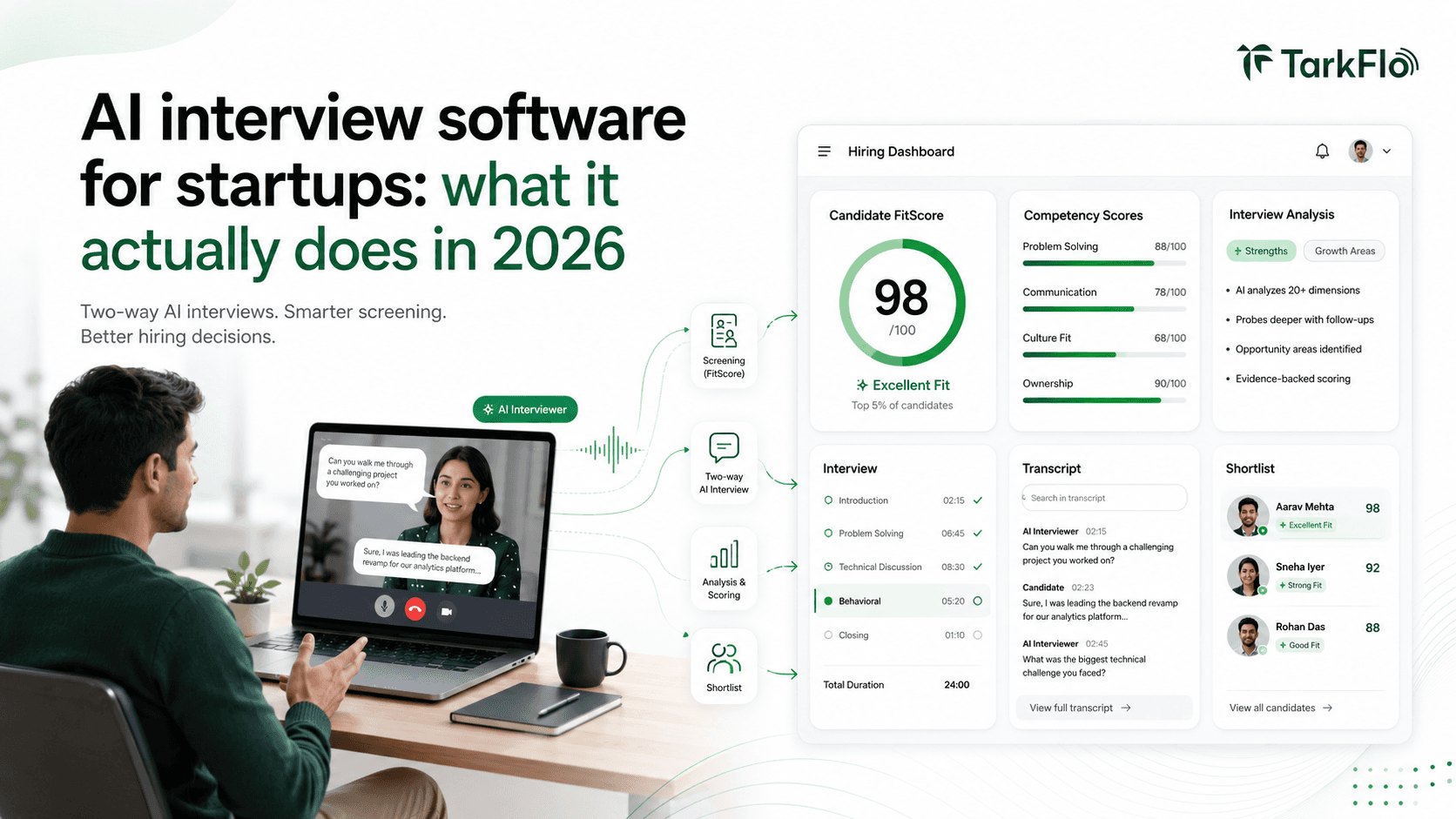
In Tarkflo, an application can move from CV screening into an AI interview without requiring a recruiter to manually coordinate every first conversation.
The important part is that the interview is conversational.
The system does not simply ask every candidate the same list of questions and collect recordings.
The next question can depend on the previous answer.
If a candidate says they improved customer response time, the interviewer can ask how they measured it.
If they mention handling an angry customer, it can explore what actually happened.
If an answer is vague, it can probe.
If an answer is strong, it can go deeper.
The result is not just a completed interview.
It is evidence.
From CVs to Evidence
A CV is a claim.
An interview gives you an opportunity to test that claim.
That distinction matters.
Consider two candidates applying for a customer support role.
Candidate A has a polished resume with impressive formatting and all the expected keywords.
Candidate B has a basic resume that barely gets past a traditional screening filter.
But during the interview, Candidate B explains a difficult customer situation clearly, demonstrates strong communication, and describes exactly how they resolved the problem.
A resume-first process may never discover Candidate B.
A conversational process can.
That is one of the reasons we believe the interview should not be treated as a checkbox between “application” and “hired.”
It should produce useful evidence that helps someone make the decision.
The Recruiter Should Not Have to Read Every Interview
Of course, there is another problem.
If you interview hundreds of candidates with AI, you cannot simply replace 500 recruiter calls with 500 hours of transcript reading.
That would move the bottleneck instead of removing it.
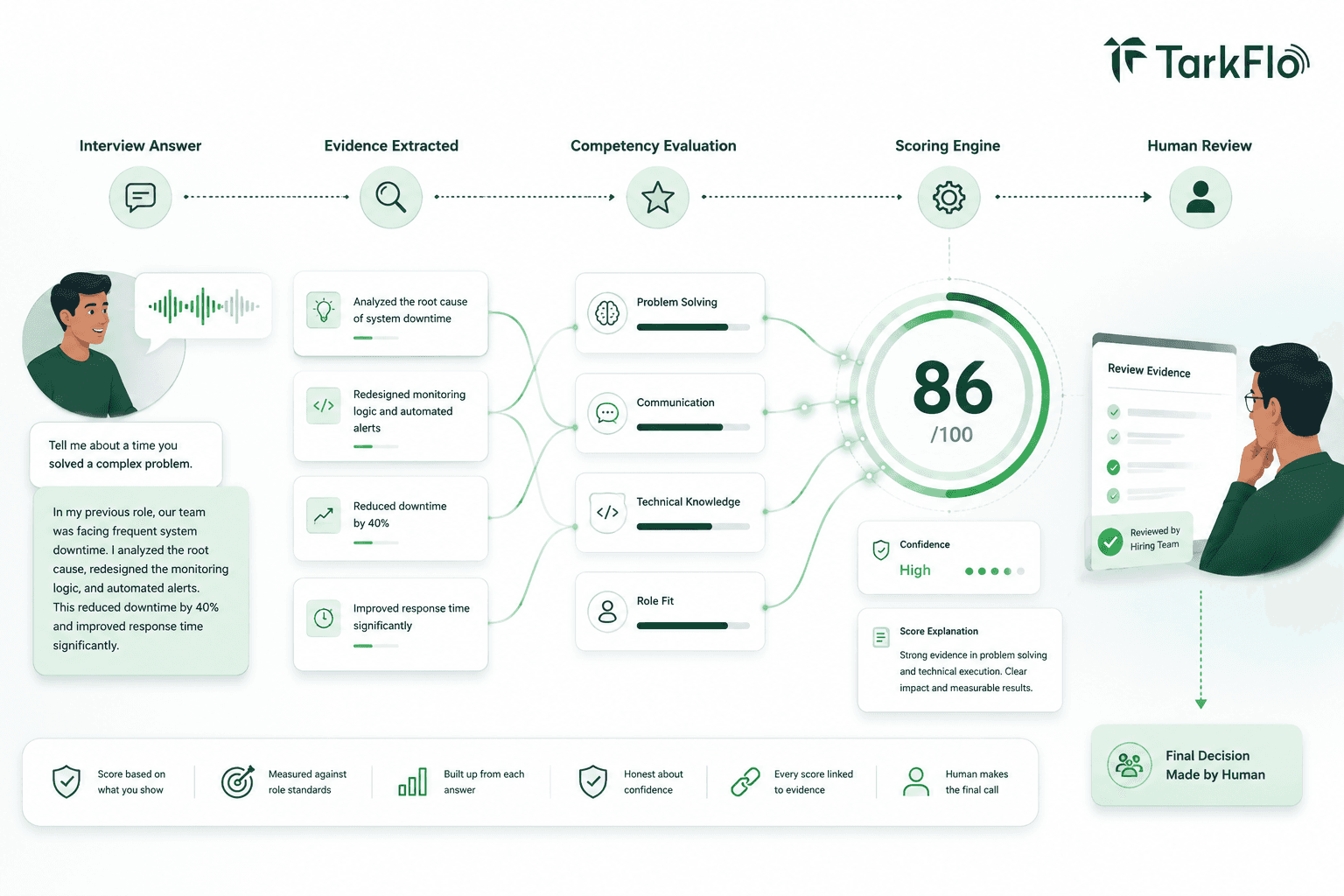
So the system needs to turn conversations into structured information.
Each interview can be evaluated against the criteria defined for that role. Scores can be connected to the underlying evidence in the conversation, giving recruiters something much more useful than a mysterious “AI score.”
Instead of opening a pile of applications, the recruiter can start with a ranked shortlist.
Instead of listening to every first-round interview, they can review the candidates who need their attention.
And this is where we started thinking beyond the ATS itself.
What If You Could Talk to Your Hiring Data?
Once interviews, transcripts, scores, CVs, evaluations, and candidate information are all sitting inside the hiring system, another problem appears.
There is a lot of useful information.
Finding it is the problem.
A recruiter might want to ask:
- Which candidates have strong communication skills and BPO experience?
- Why did these five candidates score higher than the rest?
- Which candidates have experience handling difficult customers?
- Show me the strongest candidates who are available for night shifts.
- What are the most common reasons candidates are failing this role?
- Compare the top candidates and show me the evidence behind their scores.
Traditionally, answering those questions means searching through resumes, spreadsheets, interview notes, recordings, and ATS filters.
We thought there should be a better interface.
That is why Tarkflo has Lens.
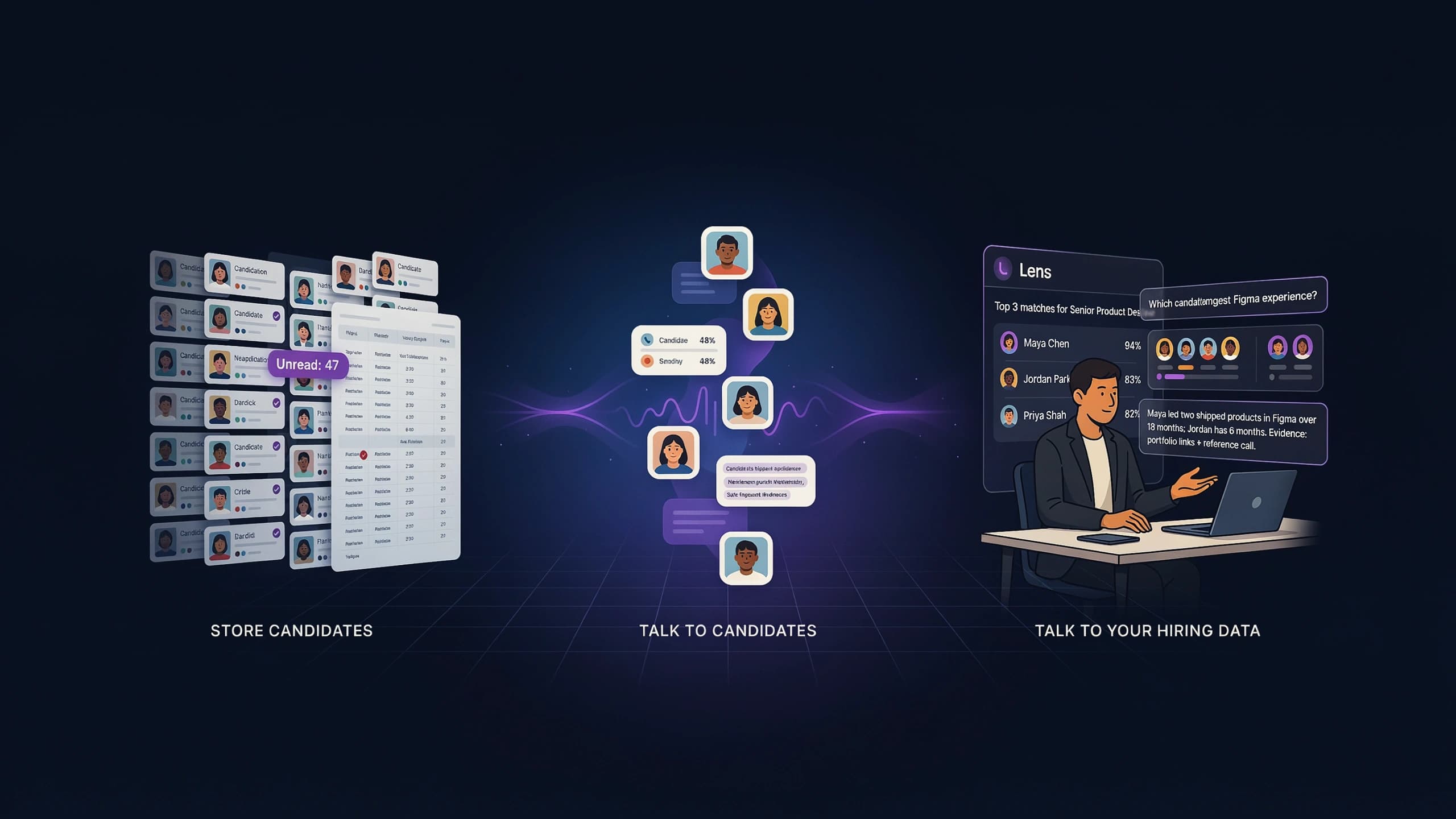
Lens is the conversational intelligence layer over the hiring data inside Tarkflo. Instead of learning another complicated reporting interface, recruiters can ask questions about their candidates, interviews, and hiring pipeline in natural language.
The important distinction is this:
The AI interview talks to the candidate. Lens talks to the hiring team.
One creates the evidence.
The other helps you understand it.
From Applicant Tracking to Hiring Intelligence
This changes how we think about an ATS.
A traditional ATS looks roughly like this:
Candidate → Application → ATS → Recruiter
A conversational ATS looks more like:
Candidate → AI screening → Conversation → Evidence → Shortlist → Recruiter
And with Lens, the recruiter gets another layer:
Recruiter → Lens → Hiring data → Evidence → Decision
The ATS is no longer just a database sitting between the candidate and recruiter.
It becomes an active part of the hiring workflow.
Where Humans Still Matter
This does not mean we think AI should make every hiring decision.
Quite the opposite.
Hiring is consequential. A score is not a verdict, and an algorithm should not become an excuse to remove accountability from the process.
Our approach is to automate the repetitive work while keeping humans involved where judgment matters.
AI can screen.
AI can interview.
AI can summarize.
AI can surface evidence.
AI can help recruiters find patterns across hundreds or thousands of candidates.
But the hiring team should still be able to understand why a candidate was surfaced, review the underlying evidence, and make the final decision.
That principle is important to us because the goal is not to replace recruiters.
The goal is to give recruiters back the time that disappeared into repetitive screening.
Who Actually Needs a Conversational ATS?
Not everyone.
If you have a small number of highly specialized roles and a recruiting team that has plenty of time to speak with every applicant, your existing ATS may be perfectly fine.
The problem becomes much more obvious when applications arrive faster than humans can process them.
That includes:
- BPOs hiring hundreds or thousands of voice-process candidates
- Customer support and sales teams hiring continuously
- Staffing agencies competing on speed of candidate submission
- SMBs where one or two people handle the entire recruitment process
- Fast-growing companies receiving hundreds of applications for every opening
In all of these environments, the bottleneck is remarkably similar.
There are more conversations to have than there are humans available to have them.
We Are Not Trying to Build Another ATS
That is probably the simplest way to explain what we are building at Tarkflo.
We do not want recruiters to spend their day moving candidate cards from one column to another.
We want the system to do more of the work that happens between application and decision.
We want candidates to get a response quickly.
We want interviews to happen without waiting days for a calendar slot.
We want every candidate to be evaluated against the same role-specific criteria.
We want recruiters to see evidence instead of just scores.
And when the hiring data becomes too large to navigate manually, we want recruiters to be able to simply ask.
That is what we mean by a conversational ATS.
The candidate can talk to the system. The recruiter can talk to the system. And the system can finally do some of the work in between.
Try It on a Real Role
The easiest way to understand this category is not another product demo.
Take a real opening.
Put real applicants through the process.
Compare the shortlist with the one your team would have built manually.
Look at the evidence behind the rankings. Ask Lens questions about the candidate pool. See how much recruiter time the process actually saves.
Because ultimately, that is the test we care about.
Not whether the ATS has more features.
Whether your team can make better hiring decisions, with less repetitive work, while candidates move through the process faster.
That is why we built a conversational ATS.