
AI interview software helps a startup collect and review first-round candidate answers before a founder or hiring manager spends time on a live interview. Depending on the tool, it may use recorded prompts or a two-way conversation with follow-up questions. The useful output is evidence you can check against the role, not simply a ranked list.
Choose a tool only after deciding what you need to learn from candidates, who will review its assessments and what should remain a human conversation. This guide gives you a practical way to compare options for technical and sales hiring.
Decide which part of hiring needs help
Start with the task that takes time today. If the problem is reading applications, CV screening may be enough. If you repeatedly ask candidates about the same work experience, an interview step may help you collect that evidence. If your team loses track of decisions, look at the applicant tracking workflow as well.
Keep these functions separate in your evaluation. A CV can describe experience without demonstrating it. A spoken answer can explain a technical decision without showing whether someone can write working code. Plan a relevant work sample or a human technical discussion when the role requires one.
- CV screening: compare the information in an application with the requirements of the role.
- First-round interview: collect examples of how a candidate approaches relevant work.
- Work sample: examine a task that resembles the work the person would actually do.
- Human review: resolve uncertainty and decide who should move forward.
Write the scorecard before watching a demo
Define the skills that matter and what credible evidence would look like. Separate essential requirements from preferences that a good candidate could learn after joining. Avoid treating a familiar employer, college name or polished delivery as a substitute for ability.
For a backend developer, ask how the candidate investigated a production incident. Look for their own contribution, the evidence they checked and the trade-off behind the fix. For a sales development representative, ask them to explain a prospecting decision and what changed after a prospect replied. A strong answer should describe actions and reasoning, rather than repeat a job description.
Use the same core criteria across candidates for the same role. Allow relevant follow-up questions, but do not quietly change the standard after seeing an impressive CV.
Check whether you can challenge a score
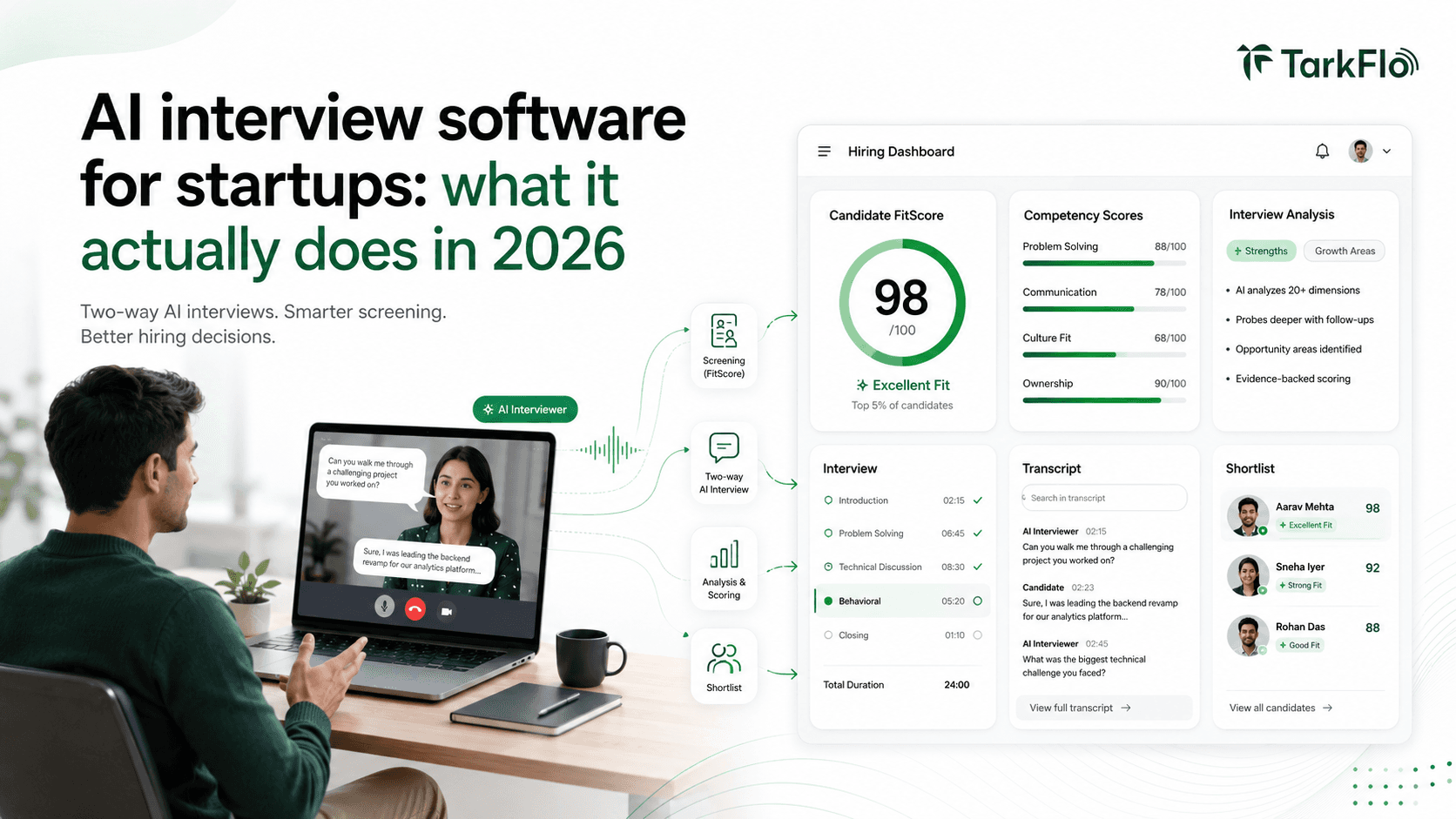
Ask to inspect a complete candidate report during the demo. Start with one assessment and trace it back to the answer. Check whether the explanation supports the score, whether important context is missing and whether a recruiter can record a different judgement.
A transcript also needs checking when wording affects the decision. A misunderstood technical term or an interrupted answer should lead to clarification, not an assumption about the candidate. Ask the vendor how your team can investigate uncertain or incomplete results.
- Can I see the question, candidate response and evaluation criteria together?
- Does the assessment distinguish a missing answer from evidence of weak performance?
- Can a reviewer record an override and explain the reason?
- Can we identify which claims still need a human follow-up?
- Who can access the candidate record, and how do we manage retention and deletion?
Try the candidate experience yourself
Complete the interview on the devices and connection conditions your applicants are likely to use. Check the invitation, instructions, microphone setup and recovery after an interruption. Confirm that the candidate knows an AI system is involved and how to contact a person.
Ask about available languages and support for candidates who cannot use the standard format. Do not assume every language or accessibility need is supported because a vendor describes its product as multilingual. For a role where communication matters, define the work-related communication skill you need. Accent or speaking speed alone should not stand in for it.
Calculate the cost of your actual hiring workflow
Ask for a written estimate based on one real vacancy. Include expected applications, the number invited to interview, interview duration, recruiter access and the features your team needs. Check what happens when a candidate retries or an interview is interrupted.
Compare the full workload as well as the invoice. Record time spent configuring the role, helping candidates, checking reports and correcting mistakes. A low headline price is not enough if the team has to recreate every assessment elsewhere. Check current Tarkflo pricing for the relevant plan and confirm feature availability before buying.
Make the purchase decision from a small evaluation
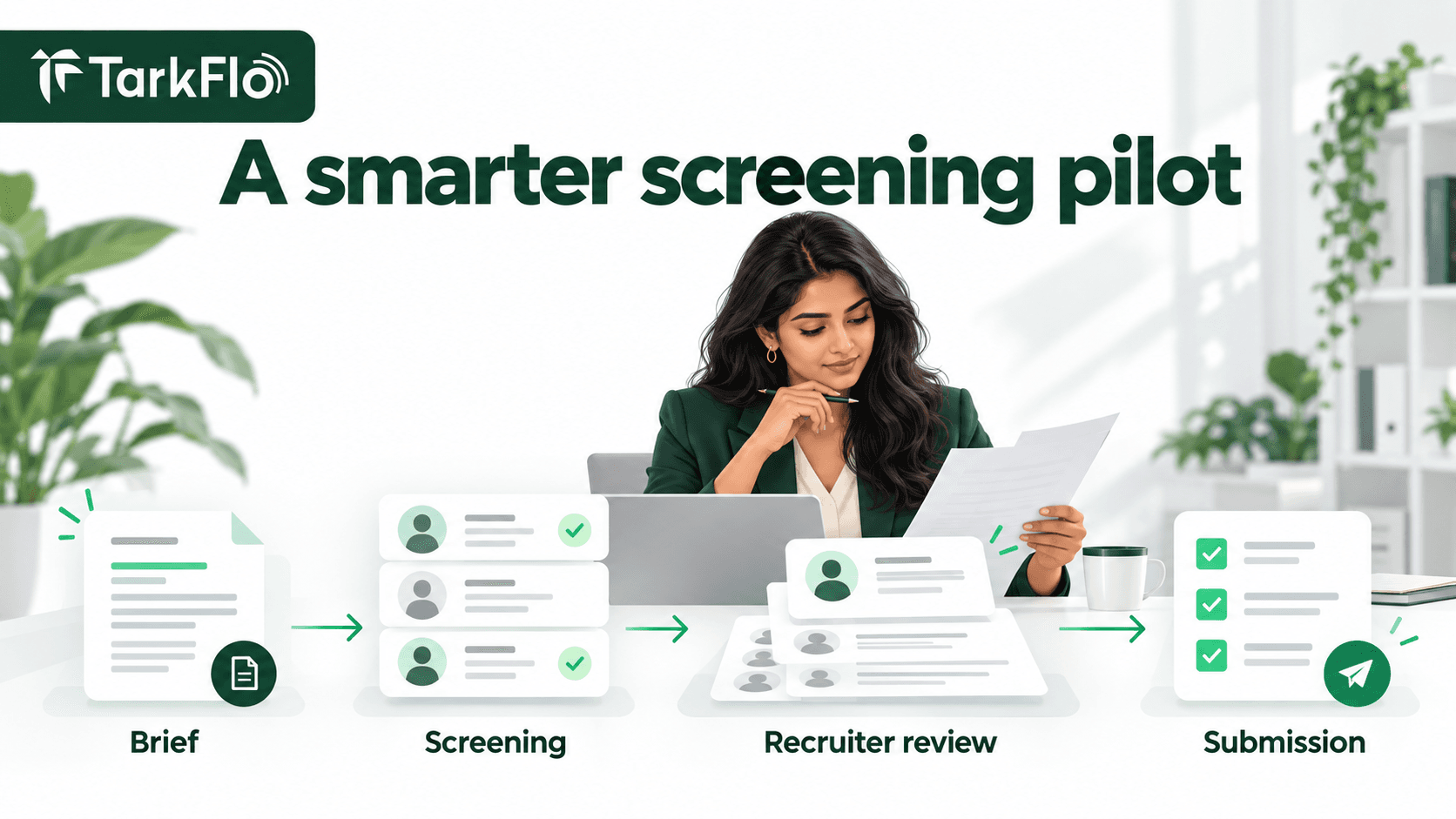
Use one live role and a clearly defined group of applicants. Have a reviewer apply the agreed scorecard independently before looking at the AI assessment. Compare disagreements and inspect evidence for candidates the tool ranked lower, as well as its strongest recommendations.
Decide in advance what would justify continuing. You might require usable evidence, manageable review effort and a candidate experience your team is comfortable offering. A small evaluation can reveal problems with your workflow. It cannot establish that a system is unbiased or predict long-term hiring performance.
Where Tarkflo fits in the evaluation
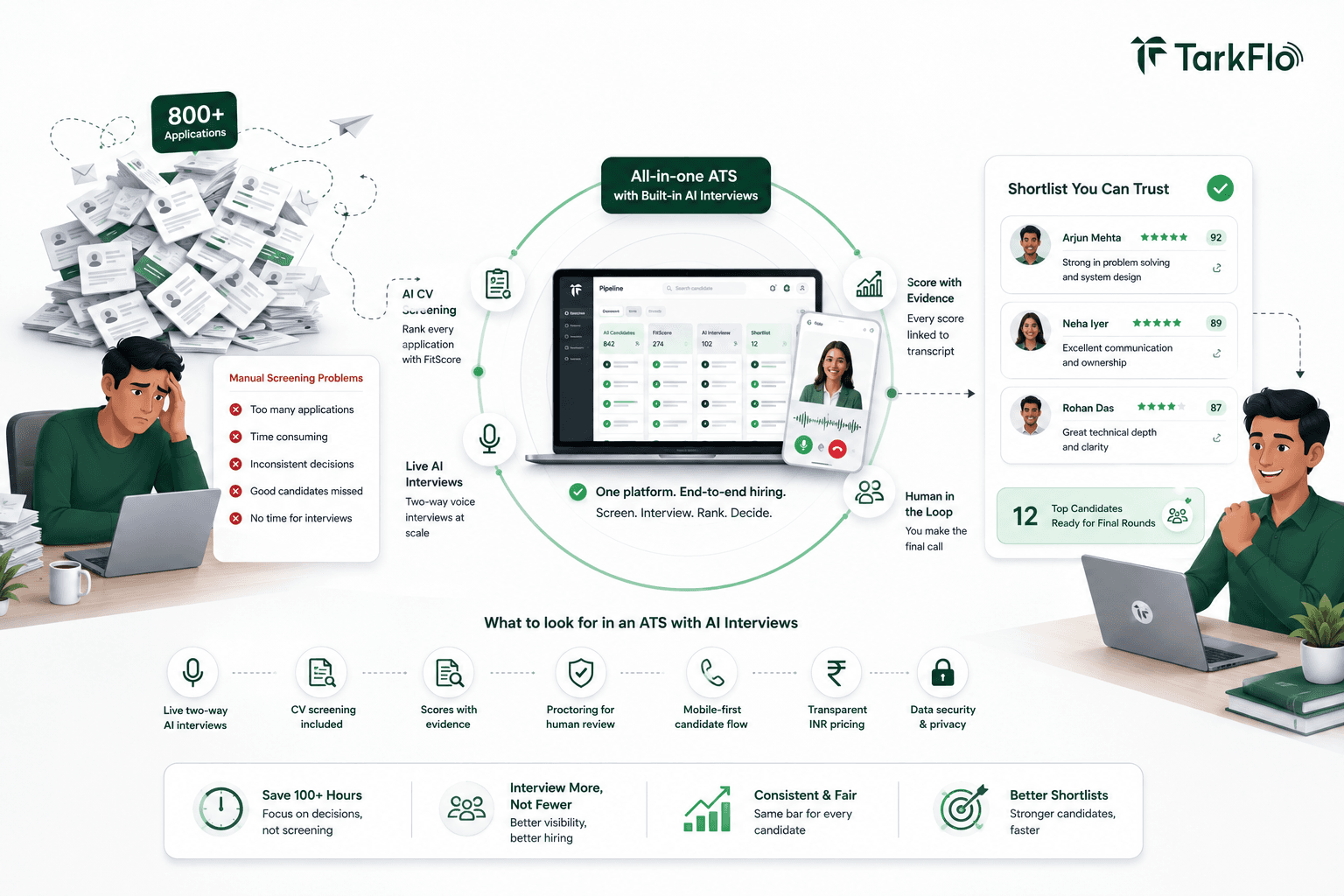
Tarkflo combines CV screening, two-way AI interviews and candidate reports with scores and transcripts for recruiter review.Lens lets teams explore candidate and interview information through natural-language questions. Hiring decisions remain with your team.
Use the startup hiring overview to see the intended workflow, then test it against your own scorecard. Confirm the features available in the plan you are considering. Choose based on evidence your hiring team can use, rather than the most impressive demo.
Evaluate Tarkflo for your next startup role
Explore the screening, interview and review workflow before deciding what your team needs.