On this page
- The Resume Rarely Tells the Full Story
- Communication Quality Predicts More Than Accent
- Consistency Matters More Than First Impressions
- The Hidden Signals High Performers Share
- Scenario Based Interviews Reveal Real Potential
- Data Beats Guesswork
- Why AI Is Changing High Volume Hiring
- What Leading BPOs Are Focusing On
- How Tarkflo Helps Teams Hire Better at Scale
- Final Thoughts
A candidate has a polished resume, speaks confidently during the interview, and seems like the perfect fit. They receive an offer, join the team, and within a few weeks, the performance gaps start to appear.
Now imagine repeating this process hundreds of times every month.
For BPOs and customer support organizations that hire at scale, even a small hiring mistake becomes expensive. Replacing a single frontline employee can cost anywhere from 30 to 50 percent of their annual salary once recruitment, onboarding, training, and lost productivity are considered. Multiply that across thousands of hires, and the impact is significant.
The real challenge is not hiring faster. It is predicting who will actually perform well once they start taking customer calls.
So what separates high-performing voice agents from candidates who simply interview well?
The answer is more interesting than most people think.
The Resume Rarely Tells the Full Story
Resumes are great at showing where someone has worked.
They are much less effective at revealing how someone communicates under pressure, how quickly they process information, or how they respond to an upset customer.
In voice-based roles, success depends on qualities that are difficult to capture on paper.
For example:
- Can the candidate explain a complex idea in simple language?
- Do they stay calm when faced with unexpected questions?
- Can they actively listen instead of waiting for their turn to speak?
- How naturally do they build rapport with another person?
These skills often matter more than years of experience.
In fact, many successful BPOs have discovered that candidates with less experience but stronger communication skills consistently outperform experienced applicants who struggle to engage customers.
Communication Quality Predicts More Than Accent
One of the biggest misconceptions in voice hiring is that accent determines success.
It does not.
Customers care far more about clarity, empathy, confidence, and problem solving than whether someone sounds exactly like a native speaker.
Think about your own customer service experiences.
You are much more likely to appreciate an agent who listens carefully, understands your issue, and resolves it quickly than someone with a perfect accent who struggles to communicate.
The best voice agents know how to make customers feel heard.
That skill is incredibly difficult to identify through resume screening alone.
Consistency Matters More Than First Impressions
Traditional interviews often depend on human judgment.
Two interviewers may evaluate the same candidate very differently. One may value confidence while another focuses on technical knowledge.
This inconsistency becomes a serious problem when hiring hundreds or thousands of people every month.
Structured interviews solve this challenge by ensuring every candidate answers the same core questions under similar conditions.
This creates a level playing field and makes comparisons much more reliable.
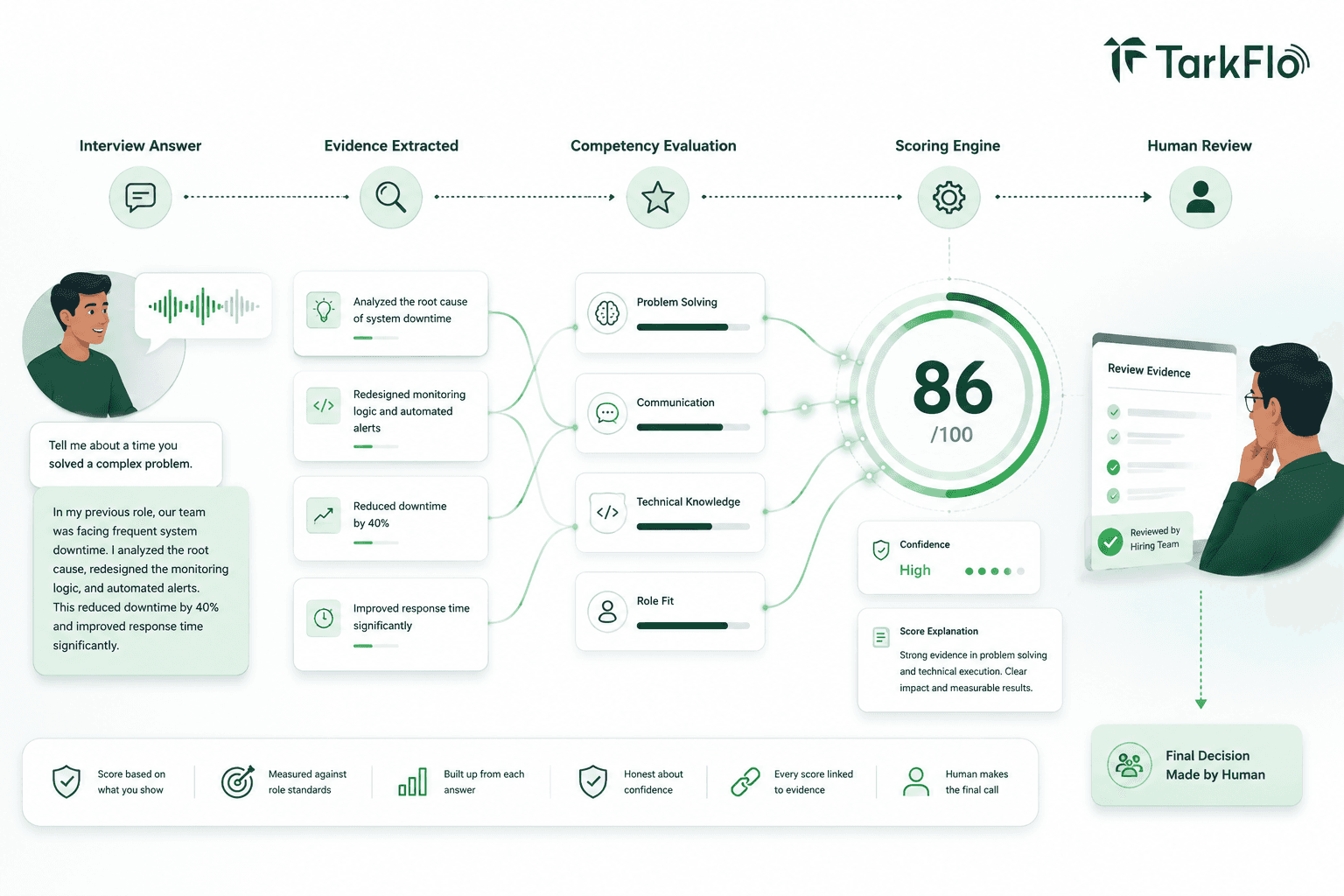
When every candidate is evaluated against the same criteria, hiring decisions become based on evidence rather than instinct.
The Hidden Signals High Performers Share
High-performing voice agents tend to exhibit patterns that go beyond technical knowledge.
Recruiters often notice traits such as:
- Clear and organized communication
- Strong listening skills
- Confidence without sounding rehearsed
- Emotional control during difficult conversations
- Ability to think before responding
- Genuine curiosity about solving customer problems
None of these qualities can be measured by simply checking a resume.
They become visible during realistic conversations and scenario-based interviews.
Scenario Based Interviews Reveal Real Potential
Imagine asking a candidate:
"A customer has been waiting for twenty minutes and starts the conversation by saying, 'I am tired of calling your company. Nobody is helping me.' What would you say?"
There is no perfect scripted answer.
What matters is how the candidate responds.
Do they acknowledge the customer's frustration?
Do they remain calm?
Do they take ownership of the issue?
Do they guide the conversation toward a solution?
These responses often predict real job performance far better than theoretical interview questions.
Data Beats Guesswork
One fascinating trend in modern hiring is that organizations are moving away from relying solely on intuition.
Instead, they are using structured interview data to identify patterns among successful employees.
Over time, companies begin to answer questions like:
- Which communication traits correlate with top customer satisfaction scores?
- Which interview responses predict faster onboarding?
- Which candidates are more likely to stay with the company for a year or longer?
These insights help hiring teams improve with every recruitment cycle.
The interview stops being just a conversation.
It becomes a source of valuable hiring intelligence.
Why AI Is Changing High Volume Hiring
High-volume recruitment creates a simple math problem.
If a recruiter spends just 30 minutes interviewing each candidate, interviewing 1,000 applicants requires more than 500 hours.
That is over 12 full-time work weeks for a single recruiter.
AI does not replace recruiters.
It removes repetitive work so recruiters can focus on decisions that require human judgment.
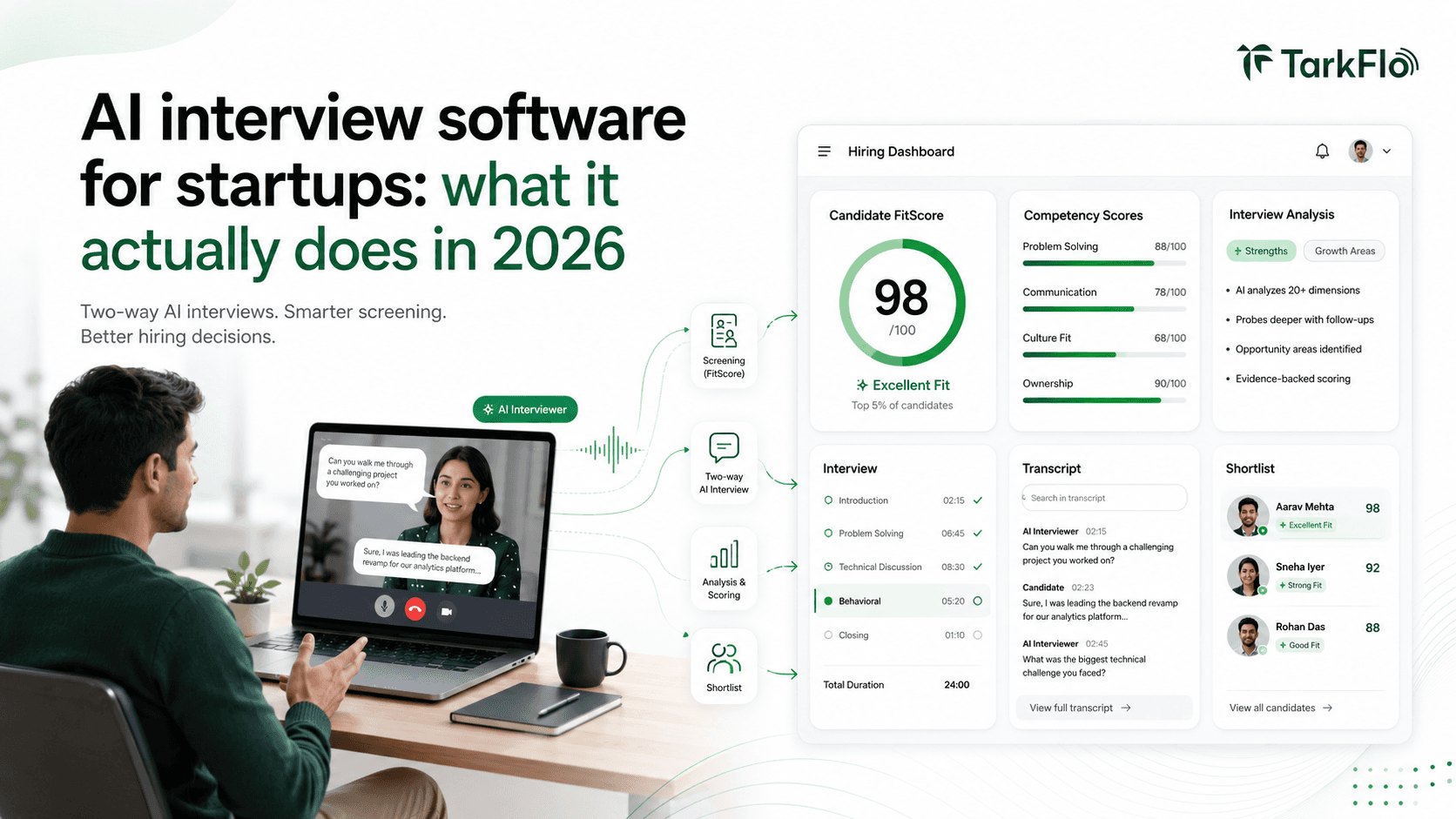
An AI interview platform can conduct structured interviews, evaluate communication consistently, generate summaries, and highlight candidates worth deeper review.
Recruiters still make the final hiring decision.
They simply spend their time on the most promising candidates instead of repeating the same screening interview hundreds of times.
What Leading BPOs Are Focusing On
Forward-thinking hiring teams are shifting their attention from credentials to capabilities.
Instead of asking, "Where has this person worked?"
They increasingly ask:
- Can this person communicate clearly?
- Can they build trust quickly?
- Can they handle difficult conversations?
- Can they adapt to unexpected situations?
- Will they represent our brand well on every customer interaction?
These questions are much stronger predictors of long-term success.
How Tarkflo Helps Teams Hire Better at Scale
At Tarkflo, we built our AI interview platform around a simple idea.
Hiring at scale should not mean compromising on quality.
Tarkflo helps BPOs and customer support teams conduct structured AI interviews that evaluate communication, role-specific skills, and behavioral responses consistently across every candidate.
Recruiters receive interview summaries, candidate insights, and standardized evaluations, allowing them to identify high-potential candidates faster while creating a fair and consistent hiring experience.
The result is a hiring process that scales without losing the human focus that great recruitment requires.
Final Thoughts
The best voice agents are not always the ones with the longest resumes or the strongest first impressions.
They are the people who communicate with empathy, think clearly under pressure, and solve customer problems with confidence.
As hiring volumes continue to grow, organizations that identify these qualities early will build stronger teams, reduce turnover, and deliver better customer experiences.
The future of BPO hiring is not about interviewing more candidates.
It is about identifying the right candidates with greater confidence.